Writing a novel in public
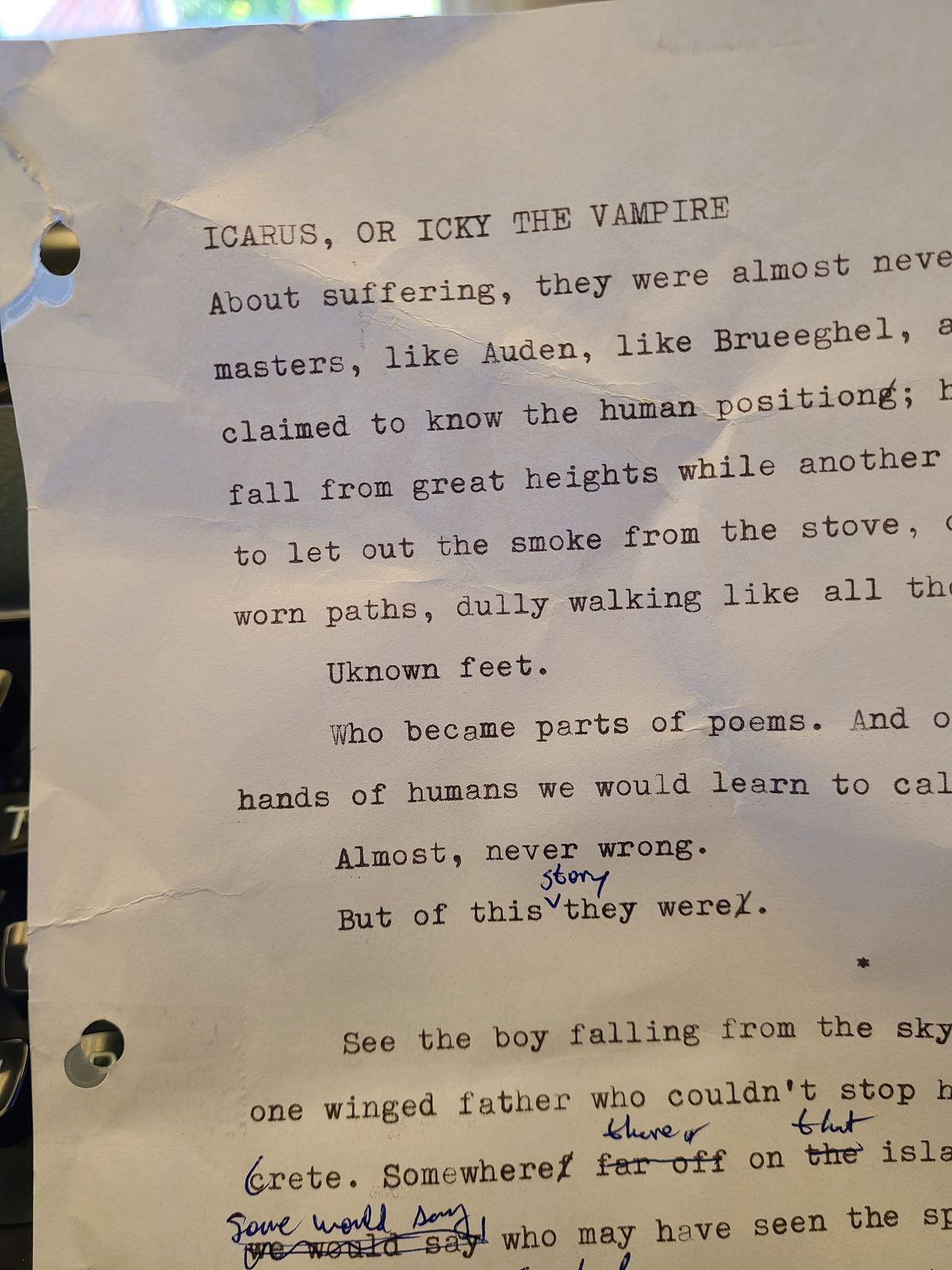
I'm not a fast writer. But this school year, I'm trying to be one along with my students.
This fall, as a demonstration of lingering head trauma or general poor decision making, I pitched a 'Fast Writing' course at Hollins University. Students will experiment with the habits and processes of prolific writers. I promised I'd participate too.
And in that participation, so I can prove it, (and hopefully learn to do this), I'm drafting of a vampire novel and will publish it one chapter at a time here first on this site, and secondly on an outside site called An Archive of Our Own.
In trying to think through this thing, and my initial plans for the class, I sent out a long letter via email. I'm sharing it below. But the big thing here to know is that for the next few months, I'm going to post chapters of this novel.
Wish me luck.
Note to the Fast Writing Course:
Dear students and friends who are interested in this fall's Fast Writing course,
I'm not a fast writer. Often, when I sit down to write, I lay down some words that feel right, especially after the hesitant few first minutes, or half hour, and then I forget how anxious I am about finding the right words, whether there are some lazy adverbs and then I lay down something that I forget about all the stuff except what is in front of me on the paper, the typewriter, the screen and then when a timer rings or I feel exhausted, I leave the work and do other things. When I go back and read what I've written, I'm aghast at what I wrote, then I either move on and write the next section, or I bog down on those words and try to make them right. Throughout the process I grope for the right word, or I reach into my knowledge of what I know to be good and ask why this selection of 'right words' don't lead the reading eye to continue, or...
I can continue, but the sense of frustration is probably palpable by now. I've always envied those writers who can bang out a book in two weeks or a month or, hell, in a year. (This is my dream). This class is my attempt to answer this question: what if I (or my students) really, truly, let go and tried to write quickly? Fast?
The fast writers I know of often write in what we describe as the 'genre fictions.' When we reach for a vampire romance, we're not reaching for the symbolic play of words that create something in our skull that can't be articulated in another way: we're hoping for a page turner that has sexy vampires and romance. A spy thriller about James Bond has cool gadgets and a STD spreader event. Fantasy, the mythic worlds of legend and folklore past and magic. (That ur sense of depth I mentioned earlier is the domain of 'literary').
So, this is what I'm aiming to do: follow the advice of genre writers (some traditional, some self-published (and no, before you levy your scorn, the modern self-publish author of today who makes a living off writing quickly seems to have filled the gap of what used to be filled by the penny-dreadfuls and other paperbacks) who write quickly and, at least in my estimation, well, in their genres).
So, what are these processes? Of course, there isn't one agreed path up this mountain. Here are a few things that every piece of advice (that seems worthwhile) agrees on:
· There must be a measurement of output. Often this is word count. Stephen King in On Writing advocates writing roughly 2,000 words a day, six days a week. Many others rely on 1,000 words a day. Some less, some more. Anthony Trollope, perhaps the OG of fast writing advice, said he aimed for 250 words every fifteen minutes, right after he had read the words he written the day before and his coffee, and before his shift at the post office.
· In lieu of word count, writers often measured their writing based on hours a day. Yet, this seems less an emphasis of genre writers who are aiming at writing a lot. However, I've never heard of a prolific or any quality writer of any stripe who didn't devote serious time to writing. The advice I've heard that "even 15 minutes a day can lead to a novel in X time!" negates that on the when hand it's true that days happen where a writer can only devote a bit of time to writing, that doesn't discount the serious devotion of writing time that occurs for laying down those pages.
· There are deadlines. Often, these deadlines have outside consequences. Think editors, readers, court dates, etc.
· The understanding that just because you finish a project, it doesn't mean that it's any good. Ray Bradbury advocated writing a short story a week. And by that process of writing one a week, by the end of the year some of them are bound to be good. However, most of them would never see the light of day. All writers I know have a few projects, written, and reside any number of folders, drawers, and are simply not very good by one definition or another. This is a freeing prospect, I think, where each piece isn’t too precious as to inhabit the idea that it must be perfect.
· Finally, everyone reads a lot. This often skews toward the genres the writer loves, but it is also the case that we read a bunch of other stuff. Again, Bradbury (whose book of essays Zen in the Art of Writing is on my desk right now) wrote about the great habit of reading a story, an essay, and a few poems every day. And no, social media in any of its forms wouldn't fulfill that requirement as far as I'm aware.
Beyond those four ideas, there are many ways up this mountain, it seems.
If you're my student entering this class, you're probably wondering what you're supposed to do with this, and what you're supposed to do in this class.
Well, here's the short description of what I'm noodling for the Syllabus (to come at some point where procrastination, anxiety, and deadlines intersect) is that we're going to investigate a few ideas of ideas of fast writing I'm aware of, and you're going to investigate a few more ideas of the writers you love, and then you're going to apply it to either a single long form piece, or a collection of pieces: a novel or novella, a story collection, an essay collection, or a poetry collection.
You can pick a process early on and ride that process for the whole semester. You could apply a different process for each distinct 'section.'
For example, if you're doing an essay collection, you could apply a Bradbury process of writing a whole draft of the short essay on Monday and then edit that draft four times (a new draft each day) and then on Friday or Saturday call it done. On the next essay, you could apply a Lauren Groff type process where you write a completely new version of the essay each day without looking at the one written the day before. (I'm not saying that Groff is a genre writer, or a particularly fast writer, but she seems to get a book out every year or two. I just finished Fates and Furies, and I'm smitten with how good her writing is).
Or, you could write the next The Shining like Stephen King by writing 2000 words a day about a pair of cockroach demons seeking love in our dimension, in our America, in our time, starting each day by reading what you wrote the previous day and then picking it up from there.
I'm flexible in this because, again, I don't know, yet, what works for me, if any of these things work at all. We'll meet in class, discuss the processes, share some of what we wrote, look at hurdles we're negotiating and see if we can conjure some tricks or things to help us write that 'meet cute' moment between two cockroach demons at a Taco Bell.
At midterm and the final, you'll be writing your own 'guides' on methods of fast writing and a reflection of what seems to work, and what doesn't.
But the hard details will be written into the syllabus.
Now, I'm participating in this experiment as well. And unlike the expectations of the rest of you, I'm going to try and do this publicly. I'm not settled completely on the process I'm going to apply, but my current plan is to write a novella about Icarus as a vampire, trying to produce a chapter a week, and I will be publishing first on my private website and then a few weeks later publish on Wattpad. (I know many of you have opinions on the merits of Wattpad, and you're more than welcome to share them in tirades with me during office hours or in email, but it seems to easiest and scariest way for me to make this public for this experiment).
I'm writing to you about all of this because you're likely thinking about the coming semester. I want to hit the ground running, especially with those of you who are hungry to brave finishing a draft of something big by the end of the semester.
If that's you, then here's what you can do: look below at the advice of these writers we'll be covering in class (these are just the ones at the top of my head), and the advice from your favorite fast writers. Pick what sort of project you want to do. Choose a method that you'll start out with for at least three weeks, starting before you come back to campus. And be ready to rock and roll.
Best,
Joe
Some of the writing advice we'll be looking at:
The Autobiography of Anthony Trollope
Dorothea Brande's Becoming a Writer
Ray Bradbury's Zen in the Art of Writing
Stephen King's On Writing
Libbie Hawker's Take off your Pants: Outline your books for Faster, Better Writing