Chapter 4: A bat of beaks
In the years that follow, I watch the violet sea,
This is the fourth chapter of Icky the Vampire, part of the Draft Zero Project. If you need a reminder of what happened last chapter, you can read that here: Chapter 3: Icky Drinks.
It would be a month before I could pronounce his name, Uta-mushi. Utamushi. Or, Mushi. He has no problem pronouncing my name, Icarus, but still calls me Icky.
It is three months before I have the courage to ask him if the ferry is coming for us. The sun had just gone down and the rocks were still warm and we were building a new terrace between the crags of rocks on the west shore of our island and Mushi stopped and looked out to the sea and reached his hand out, an “L” on the dark horizon, a would be sail and boat to bob on the water. “What boat?” He said. “No boat. No, no, no, sky and sun but no, no-no.]
“Are we dead?” I asked.
“No, no, no die for us. No sky for us. Now only night.” He put his down and we moved the hot black rocks to a loose line where the rain and tide would wash the good sand flat against our new loose tide wall. With two of us, we need more clams to feed the seagulls. Each terrace, a loose line of rocks, a wall that would disappear with the tide and appear again when the new moon and the full moon was up in the sky. There were many terraces around the island, and Mushi would never stir the mud of one twice in a row it seemed.
*
After a year of nights, of shucking clams and snagging the blood of sea gulls, I wait through the day in the space just beyond the curved light from the eye of the cave. He tells me I’m wasting my time, no boats ever come by our eye of cave. But I wait. I have to hold a handful of grass, a thatch of shade. Even the glare of full sun trembles the gut and burns with heat not like fire but of poison. I squint. I wait. I hope for the ferry for Hades. I hope that Mushi is wrong when he says that he has been here on the island since it was a mountain with snow at its peak, and watched the ages melt it slowly back into the sea.
I said, “If that was so, why didn’t you swim away?”
He had, he said. “The dark of the deep was worse than here.”
“Do we die in the sun?” I asked him.
He put out his hairy foot into the pristine moonlight. He moved the hair a bit and it all seemed like waves, his pale skin. Scar. And it seemed to move in the light. “It burns even now. Always burns. It was worse before you.”
There were weeks when I thought he should have let me burn, let me die like all winged things crashed to the ground by folly or hate or by the powerful. I told him so, and he smiled and would go back deeper into the cave. Again and again I told him and he would smile and go to the dark or out to the edge of the rock shelf and stare out to the sea.
And I wait through the day, looking through the blades of thatch, and no boats came, and nothing out on the surface of the sea save for the white caps of foam, a fish leaping, maybe fleeing, and the clouds way out there that plot storms that poured through the night.
*
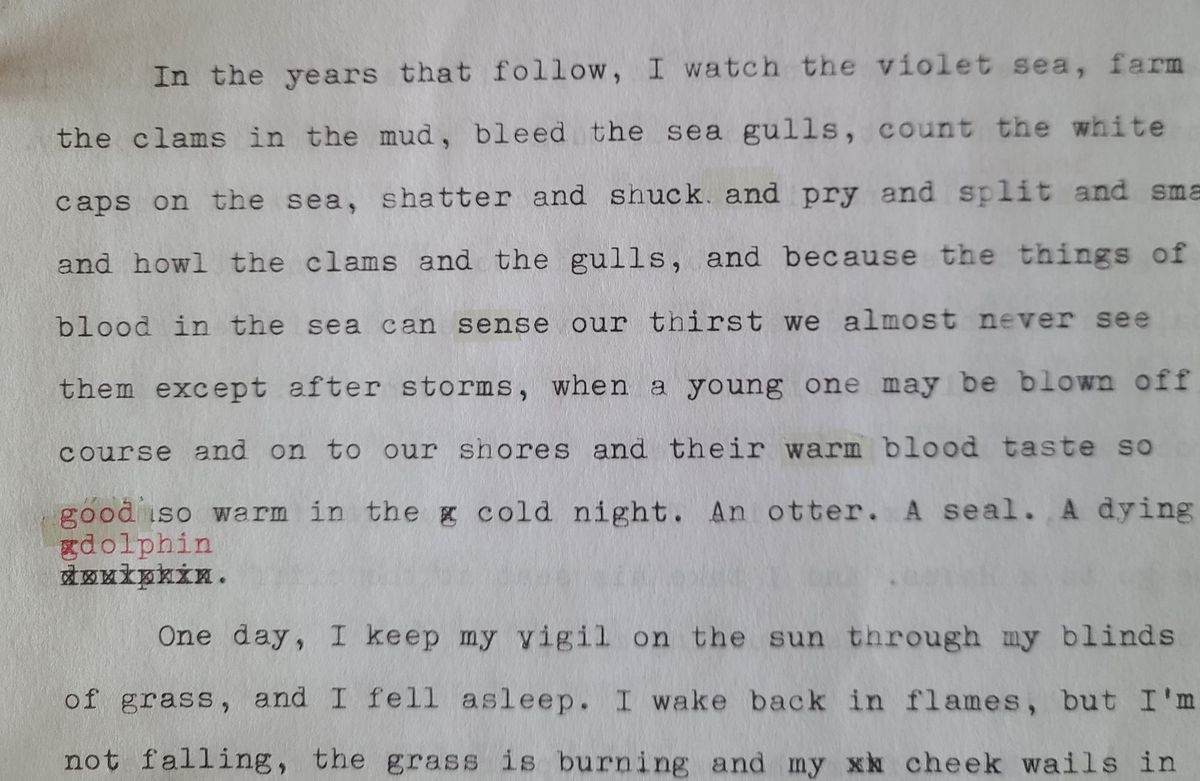
In the years that follow, I watch the violet sea, farm the clams in the mud, bleed the gulls, count the white caps on the sea, shatter and shuck and pry and split and smash and howl at the clams and the gulls, and because the things of blood in the sea can sense our thirst we almost see them except after storms, when a something young and soft and blown off course and onto our shores and their warm blood taste so good, so right in the cold night. An otter. A seal. A dying dolphin.
One day, I keep my vigil on the sun through my blinds of grass, and I feel asleep. I wake in flames, its tongues kissing and hissing at the roof of the cave and I think, yes, yes, let me fall all the way into the dark flame of hades.
But I’m not falling. The grass burned and my cheeks wailed pain. No, I’m wailing in pain, and Mushi pulls me from the light and beats me, slaps me, extinguishes me. “Is it bad?” I ask. But I know it’s bad.
“It is,” he said. “But you were never beautiful.”
In time he tells me there was only one way to heal these kinds of hurt, but he doubted it would ever come for me as it did for him.
And it burns, always, my cheeks. In the dark of the cave, on the terraced mud while claiming. No matter how much I gorge, the pain doesn’t get better. Time does nothing to heal these burns.
With the burn, other pains hurt more. I think of Ariadne’s hands and the thread she spooled and how she never heard my flute, and of how I pray to gods who don’t answer, and wish for baby dolphins and anything with a hot heart to wash ashore almost dead and of the wine dark sea where there was no wine and no hope of wine and this naked old man who didn’t let me drown or burn or starve or die properly.
So, in the night when the moon was weak and behind the sheets of clouds I go behind him as he watches the sea. I have a club of driftwood, spiked with seagull beaks. I swing it at the ball of his back of his head, and he tumbles over the side of the cliff like some doll flung from a cradle and down the staircase of rock and plunked into the ocean.
Now, I’ve done it. That’s what you get for not letting me go to Hades. And I take his seat at the cliff edge, wait for the sun to finish burning me up.
“Lumida!”
I peered over the edge. It’s Mushi from the water, bobbing. “Lumida!” He shouts. Then, he climbs out onto the shelf of rock and let from it and back up to my ledge, the height of several tall and old trees, and beside me, dripping, and huffing, he slaps me so hard I hurl, spin, flop back onto the skin of the sea, and it hurts my head, my stomach, but those were mere stings to the burn of the sun still aching through my cheek.
By the time I crawl back to our ledge, Mushi bats my club against his hand, punctuating, “Lumida, lumina, ludima.” Then, he goes silent.
“I’m sorry,” I say after my skin is dry. “I just want to die and you won’t let me.”
“You don’t want to die,” he said. “You want to feel better. Not feel at all, lumina. The gods won’t let us die. We just burn, forever. There is no silly boat for us.
“You made me. You kept me from Hades.”
“Lumida! Does a chicken decide to have an egg? Does an egg choose to hatch? Not all of them hatch.”
“I’m no chicken. I’m the boy who flew.”
“You’re no chicken? You meant egg, lumina. I’m supposed to be the chicken. And neither of us chose this, the gods did. The gods kept you alive and you washed on these shores and healed me, and you live.”
“This is living?”
“This is the way we must live.”
“We don’t die in the sun?”
“Not in the way you think.”
Out in the water, a whale blows water. It’s way out, but our eyes can see far and our ears can hear the wake of water as it grazes past the whales skin. Then it slips under the cover of water. How could Mushi sit out here for years, hundreds of years and watch the fish sleep, the water fold and foam and feed off the seagulls? I say, “How do you know we don’t die in the sun?”
“I’ve seen others try,” Mushi said.
“Others? Like us? Where?”
But Mushi says no more as he rises from this seat and jumps from the ledge and into the sea. From a nearby basin, I take armfuls of clam shells, sharp and jagged and tossed them after him. Like leafs, they float for a moment on the waves then sink out of sight.